


 Home
Home
 Solution
 Case Studies
 Blogs
Blogs


- AI Services
AI Workflow Automation: How Manufacturing Companies Save Time and Money
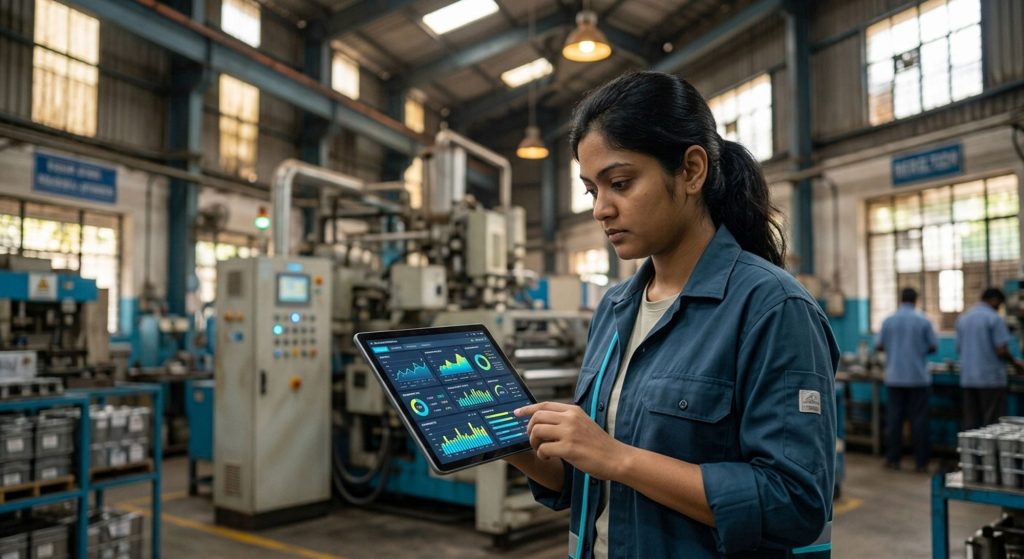
AI Workflow Automation: How Manufacturing Companies Save Time and Money
Manufacturing businesses rely on repetitive processes every day — from purchase orders and quality checks to inventory updates, vendor communication, and customer follow-ups. AI workflow automation helps handle these repetitive tasks more efficiently, allowing teams to focus on decisions that require human judgment.
What AI Workflow Automation Actually Means
AI workflow automation uses intelligent software to manage multi-step business processes. Instead of relying entirely on manual data entry, checking, and follow-up, modern AI systems can read documents, extract important information, identify anomalies, and route tasks to the appropriate person or department.
Where Manufacturing Companies See the Fastest ROI
Purchase order and invoice processing can be significantly streamlined with AI. AI systems can extract information from incoming documents, even when vendor formats differ, and transfer the relevant data into ERP or accounting systems. This reduces manual data entry and helps minimize transcription errors.
Inventory monitoring is another high-value automation opportunity. Automated systems can track stock levels across locations, identify reorder points, and analyze historical patterns to support demand forecasting. This can help reduce both stockouts and unnecessary inventory costs.
Automating Quality Control and Customer Inquiries
AI can simplify quality control documentation. Instead of manually compiling inspection information, automated systems can collect quality data, identify deviations from specifications, and assist with generating compliance documentation.
Customer inquiry routing can also become faster and more organized. AI can analyze incoming emails and form submissions, determine the appropriate department or urgency level, and route each inquiry to the right team member.

Streamlining Vendor and Supplier Communication
Routine supplier communication can often be automated without removing human involvement where it matters. Order confirmations, delivery updates, and routine status communications can be handled automatically, allowing procurement teams to spend more time on negotiations and supplier relationships.
The Cost Case: Time Saved vs Investment Required
The business case for automation comes down to the relationship between time saved and implementation cost. Manufacturing companies processing large volumes of invoices, purchase orders, or customer inquiries can accumulate significant savings when repetitive manual work is reduced. In high-volume environments, these savings can potentially offset the initial investment within months.
What's Actually Involved in Implementation
Successful automation starts with understanding the existing workflow. Every step, handoff, and exception needs to be mapped before automation is introduced. The system must then connect with existing tools such as ERP platforms, accounting software, email systems, and CRMs.
Testing with real-world data is equally important. Historical records and unusual edge cases should be tested before an automated workflow is introduced into live operations, helping identify problems that may not appear during basic testing.
Common Mistakes to Avoid
Automating an inefficient process does not automatically make it better. If the underlying workflow is broken, automation may simply make the same problem happen faster. Businesses should first improve their processes, test unusual scenarios, and regularly review automated workflows as operations evolve.
Where Human Oversight Still Matters
AI automation works best when it handles routine processes while escalating exceptions to people. A well-designed system can process a standard invoice automatically while identifying an unusual discrepancy that requires human review. This approach improves efficiency without removing important decision-making from the process.
Getting Started
Manufacturing companies don't need to automate everything at once. Starting with one high-volume, well-understood process — such as invoice processing, inventory alerts, or customer inquiry routing — provides an opportunity to demonstrate measurable value before expanding automation across more complex workflows.
Curious where AI automation could save your manufacturing business real time and money?
Our AI automation experts can analyze your existing workflows, identify repetitive processes with the highest automation potential, and recommend practical solutions designed around your manufacturing operations and existing systems.
Book Free Consultation


